Industrial system solutions for additive manufacturing of high-performance components made of advanced ceramics
D3-AM GmbH
A Durst Group Company

D3-AM GmbH
A Durst Group Company
D3-AM GmbH
A Durst Group Company
Micro Particle Jetting (MPJ)™
The key advantages of MPJ™ at a glance
At D3, we are convinced that true innovation in inkjet printing begins with a deep understanding of printhead technology and its interaction with different fluids. This forms the foundation of our Micro Particle Jetting (MPJ™) technology. By developing a specially designed and unique printhead, D3 enables the direct printing of water-based suspensions with high solid content and virtually any particle size. This facilitates the intelligent generation of droplets to produce complex, high-quality and dense components.
As a company within the Durst Group AG – an organization that has been at the forefront of inkjet technology for decades – we are committed to advancing this technology in the field of additive manufacturing.
Every component we develop is manufactured with precision and care, assembled in state-of-the-art cleanroom facilities to ensure the highest standards of quality and consistency. This meticulous process allows us to align each element perfectly, ensuring seamless integration and reliable performance.
Maximum flexibility for innovative geometries.
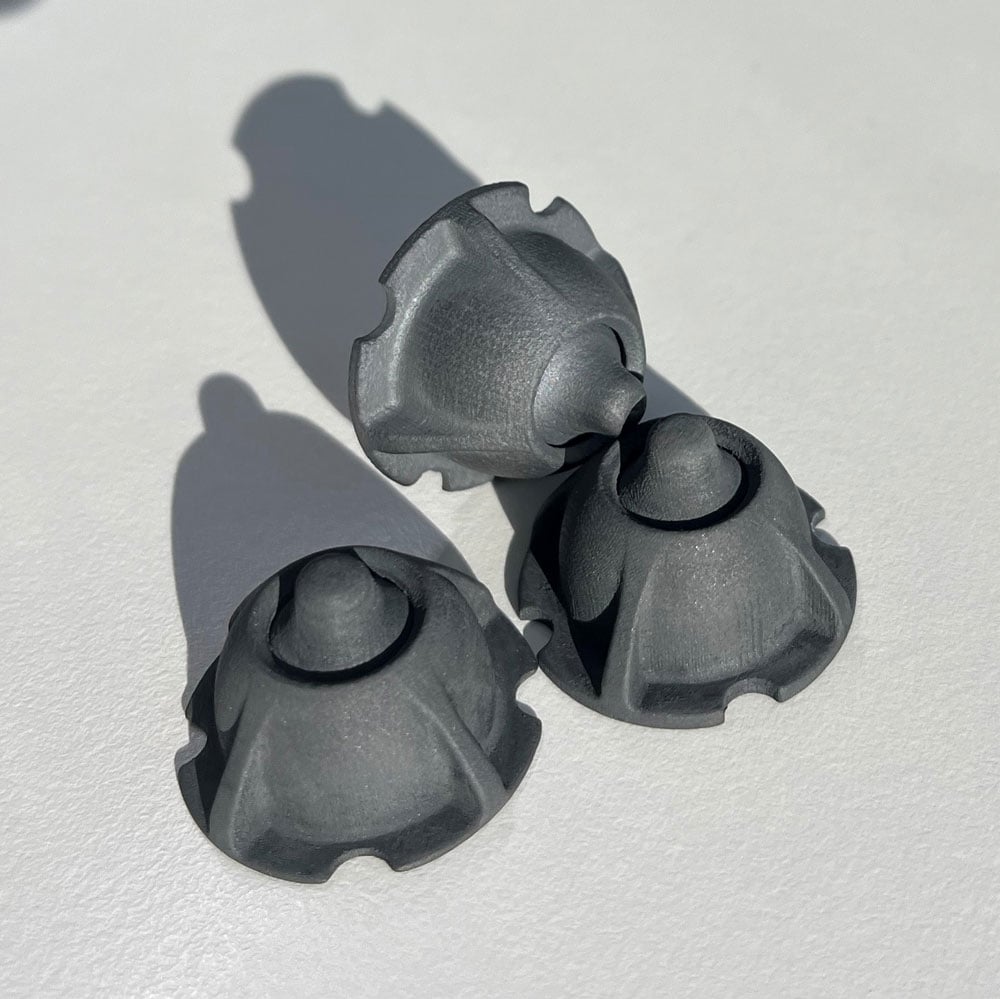
Additive manufacturing excels through its ability to apply material only where it is truly needed, making it significantly more resource-efficient than subtractive methods. With D3’s advanced technology, components can be created in virtually any shape or design. Especially complex structures, such as minimal surfaces or freeform geometries like gyroids, are not feasible using traditional manufacturing methods, as these quickly reach their limits when dealing with overhangs, cavities and varying wall thicknesses.
Even current additive manufacturing technologies face limitations in terms of wall thickness, component size, precision and post-processing. In contrast, D3’s innovative approach unlocks the full design and productivity potential of technical ceramics.
The Versatility of Technical Ceramics.
Technical ceramics are defined by their exceptional resistance to heat, chemicals and abrasion. With high wear resistance and remarkable hardness combined with low density, they are used in areas where conventional materials reach their limits. At D3, we use aluminum oxide (alumina) and sintered silicon carbide to develop innovative solutions for a wide range of applications. These materials are ideal for use in heat exchangers for high-temperature environments, pumps handling chemically aggressive fluids, as well as in the process industry, aerospace and dental technology.
Supported by

You need to load content from reCAPTCHA to submit the form. Please note that doing so will share data with third-party providers.
More Information